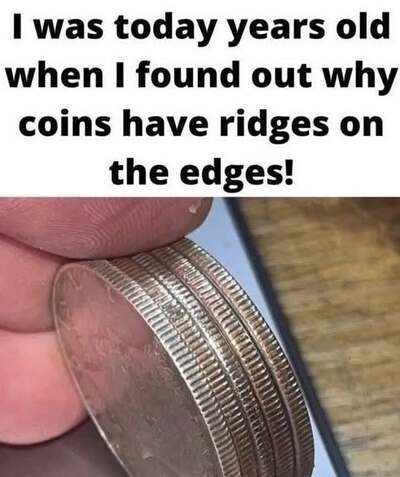

Most people have handled thousands of coins without ever giving a second thought to the tiny ridges running around their edges. They seem like nothing more than a decorative detail, but those grooves actually tell the story of one of history’s biggest battles against fraud.
Centuries ago, many coins were made from valuable metals like gold and silver, meaning their worth came from the metal itself. That led to a widespread scam known as coin clipping, where criminals shaved tiny amounts of precious metal from the edges of coins. Each coin lost only a little, making the damage hard to notice, but over time those shavings added up to significant profits while the underweight coins continued circulating.
To stop this, mints introduced reeded edges—the evenly spaced ridges still found on many coins today. If someone tried to shave metal from the edge, the missing ridges made the tampering immediately obvious. A simple design change became one of the most effective anti-fraud measures ever introduced.
The idea became especially important during the late 17th century, when Sir Isaac Newton, while serving at England’s Royal Mint, helped modernize coin production and strengthen protections against clipping and counterfeiting. His work helped restore confidence in the nation’s currency and influenced coin designs around the world.
Although today’s coins are no longer made from precious metals like their predecessors, the ridges remain for several practical reasons. They help vending machines and coin-counting devices identify genuine coins, make certain denominations easier to distinguish by touch for people with visual impairments, and continue to serve as an extra security feature against counterfeiting.
Different countries have even expanded on the idea by adding lettering, decorative patterns, or unique edge designs that reflect their history while making coins even harder to duplicate.
So the next time you find a quarter or dime in your pocket, take a closer look at its edge. Those tiny grooves aren’t there by accident—they’re a centuries-old reminder that sometimes the smallest details play the biggest role in protecting something we use every day.